The activities of penyes have always been numerous and aimed at promoting different values. Some have focused mainly on cultural activities, others on social initiatives, others even on gastronomy, and many more. However, if we look historically at most penyes located in the Metropolitan Area of Barcelona, they have generally had, from the beginning, an activity that was predominantly sporting.
Many supporters’ clubs from the 1950s and 60s were founded with this spirit, aiming to train young people through football and to identify potential future talents for FC Barcelona. There is no doubt that, during the dictatorship, sporting penyes were less scrutinized and easier to establish than social ones. The latter had to undergo numerous inspections and suffered many delays in obtaining official recognition or in their creation—often facing rejection after rejection until an influential figure within the regime helped unblock the situation.
The creation of the Association
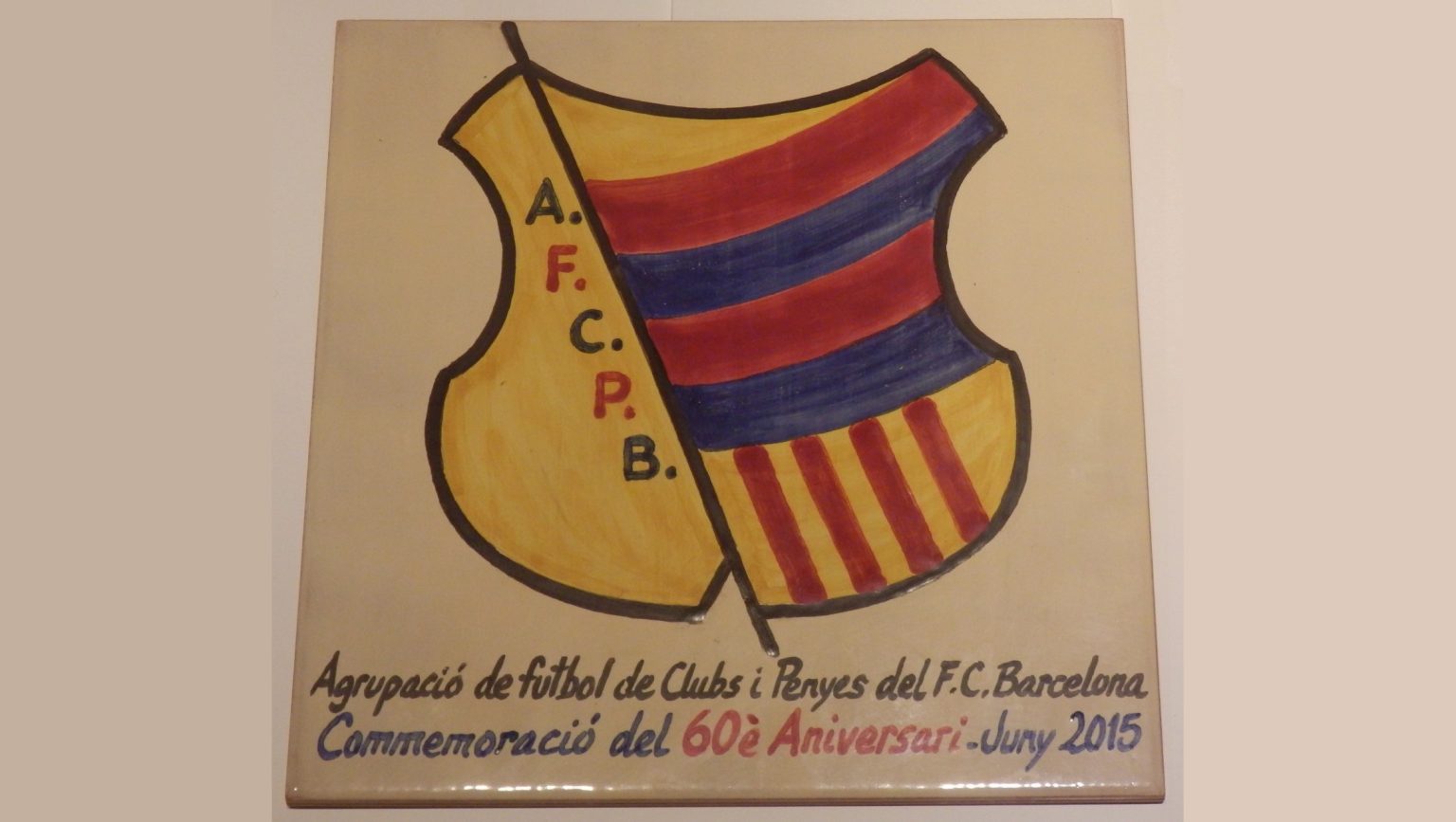
The Agrupació de Futbol de Clubs traces its origins to 15 April 1956. On that day, several representatives of Barça supporters’ groups met to create the Sports Committee of Barça Penyes, with Ramon Gasol as its first visible leader. The initial meeting took place at number 166 Bruc Street, where the gym and other facilities of Club de Fútbol Barcelona were located.
Representing the Board of Directors was Enric Llaudet, who would later become president and was then the board member responsible for the club’s sections. He gave full support to the project of bringing together the football teams of the Barça penyes. Among those present were some officially recognized groups and others that took the opportunity to become fully accredited blaugrana penyes. Some of these no longer exist today, such as Penya Alirón, Penya Kubala (later Penya Collblanc), Penya Azulgrana (Rogent), or Penya Eulogio Martínez, but others were still active in 2021, such as PB Cinc Copes, PB Barceloneta, PB Villaverde, or Unió Catalonia. PB Olivella and PB Barcino joined shortly afterwards.
First statutes
Two years later, on 30 June 1958, the first statutes of the Committee were drafted, with Ramon Gasol as the first official president. It consisted of eleven supporters’ groups and only youth teams. To join, six requirements were established: to be a strictly Barça-supporting entity, to be legally constituted, to have been officially recognized by the FC Barcelona Board of Directors, to have a youth team registered with the Catalan Football Federation, to ensure that this team competed for two consecutive years in official competitions, and to obtain a favourable report from the Committee based on the merits achieved over those two years (later extended to three).
At the Assembly held on 15 November 1961, it was agreed to change the name to the Agrupació of Sporting Penyes with a Football Team. It was not until the 1965–1966 season that the first official internal competition was organized, involving ten supporters’ groups, among them Penya Anguera.
The boost of the 1990s
It should be noted that, in the 1990s, the Agrupació had its own team that competed in the Catalan divisions and served as a showcase for new talents destined for La Masia. Former player Ferran Olivella became president of the Agrupació in 1996 and succeeded in giving it a major boost. In FC Barcelona’s Centenary season, the record number—still standing—of 27 penyes was reached.
This Agrupació, following the trend initiated by Josep Suñol i Garriga in the 1930s with his motto “Sport and Citizenship,” has always emphasized values that have endured to this day in all FCB Escola programs and in the young academy players trained at La Masia. The Agrupació recalls the fourth teams that existed during the club’s first 25 years, many of which already referred to themselves as a “penya.”
Contribution of players to the first team
The service provided by the Agrupació to FC Barcelona over the years has been invaluable and, at times, insufficiently recognized. Thanks to this work, they have proudly seen several of their members reach the FC Barcelona first team: Ramón Montesinos (PB Kubala), José Manuel Martínez Manolo (PB Cinc Copes), Canito (PB Anguera), Víctor Valdés (PB Cinc Copes), Joan Verdú (PB Anguera), Jesús Olmo (PB Trinitat Vella), among others.
It is also worth highlighting that other prominent Barça figures emerged from these teams and later excelled in various fields, such as Pedro Ruiz, Carles Naval, Joan Laporta, Sandro Rosell, Òscar Grau, Toni Freixa, or Xavi Torres. Players such as Juan Cano, Joaquín Arana, Josep Ventura, Francisco José Carrasco, or Marc Muniesa also played for penyes teams outside the Agrupació.
A whole universe that further highlights the value of the work carried out by FC Barcelona’s penyes across the various spheres and contexts of Barça culture and Catalan society.