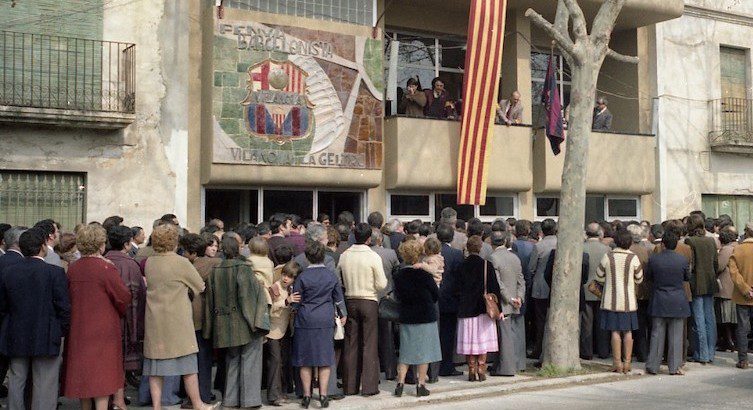
If in the previous chapter we talked about an emblematic penya from the Bages region, today we travel further south, specifically to the Federació Anoia, Alt Penedès i Garraf, to learn about another historic one: the Penya Barcelonista de Vilanova i la Geltrú. It should be clarified that the founding year of a supporters’ club is determined when there are documents proving the first founding meeting, which does not always coincide with the official recognition of the penya by FC Barcelona or the institutions of the time. If we considered creation based on officialization, FC Barcelona would not be almost 126 years old today, but three years younger – the time it took President Paul Haas to draft the first statutes of the club.
The Penya Barcelonista Vilanova i la Geltrú was founded on March 7, 1958, thanks to Eduard Mestres and the determination of a group of people whose passion for the colors was stronger than all the obstacles they faced. It was officially registered on November 24, 1960, with its first elected president: Mr. Josep Forné, one of Barça’s ten oldest members. Today, the supporters’ club has 350 members and serves as a hub for all kinds of activities, beyond sports.
History of Vilanova i la Geltrú
Vilanova i la Geltrú, the capital of Garraf, was born from the merger with the nucleus. According to legend, it emerged when residents of La Geltrú migrated toward the coast to escape feudal abuses, founding Vilanova de Cubelles. The king Jaime I granted the Carta-Puebla in 1274. In the 18th century, with trade with America authorized by Charles III, the city experienced significant economic and cultural growth, creating recreational societies and earning the nickname “Havana Xica.” The first theater, La Sala, opened in 1804. In the 19th century, industrialization began with a factory in 1839 and accelerated with the arrival of the railway, which encouraged the construction of cultural facilities such as the Víctor Balaguer Library Museum.
The city stands out for its strong associative fabric, with cultural societies gaining prominence during the Renaixença. Its architectural heritage includes stately homes of “indianos,” historic squares, romantic gardens, and sculptures. Traditional festivals are varied: Sant Antoni (Tres Tombs) in January, Carnival (a Traditional Festival of National Interest), and the Festa Major de les Neus in August, featuring parades, street performances, and popular dances such as the Ball de Diables, Giants, Mulasses, castellers, and Falcons. At Christmas, the Pastorets plays are typical. Local gastronomy is highlighted by the emblematic dish xató, served with escarole salad, tuna, and cod, closely linked to the wine tradition.
Among its museums are the Víctor Balaguer Library Museum, Can Papiol (neoclassical), the Railway Museum, Masia Cabanyes, and Espai Far, dedicated to maritime heritage. There is also the Ribes Roges park with a miniature railway circuit. Vilanova has been the birthplace of notable figures such as Víctor Balaguer, Francesc Macià, Eugeni d’Ors, Eduard Toldrà, Toni Albà, and Sergi López.
The cuisine of Vilanova is Mediterranean, featuring fresh fish from the local market and garden produce. Highlights include the Central Market (1941), seafood recipes, and sweets such as meringues, pork crackling cakes, and “moons of Vilanova.” As a tourist destination, it offers urban routes (Indianos, seafront, Rambla) and hiking trails (Mas Artís, La Talaia, Els Colls), over 7 km of fine sandy beaches with shallow waters ideal for families. Iconic spots include the Pasífae sculpture, the Sant Cristòfol lighthouse, and Plaça de la Vila. Its cultural diversity and proximity to Barcelona make it an attractive getaway to enjoy heritage, gastronomy, and the sea.