
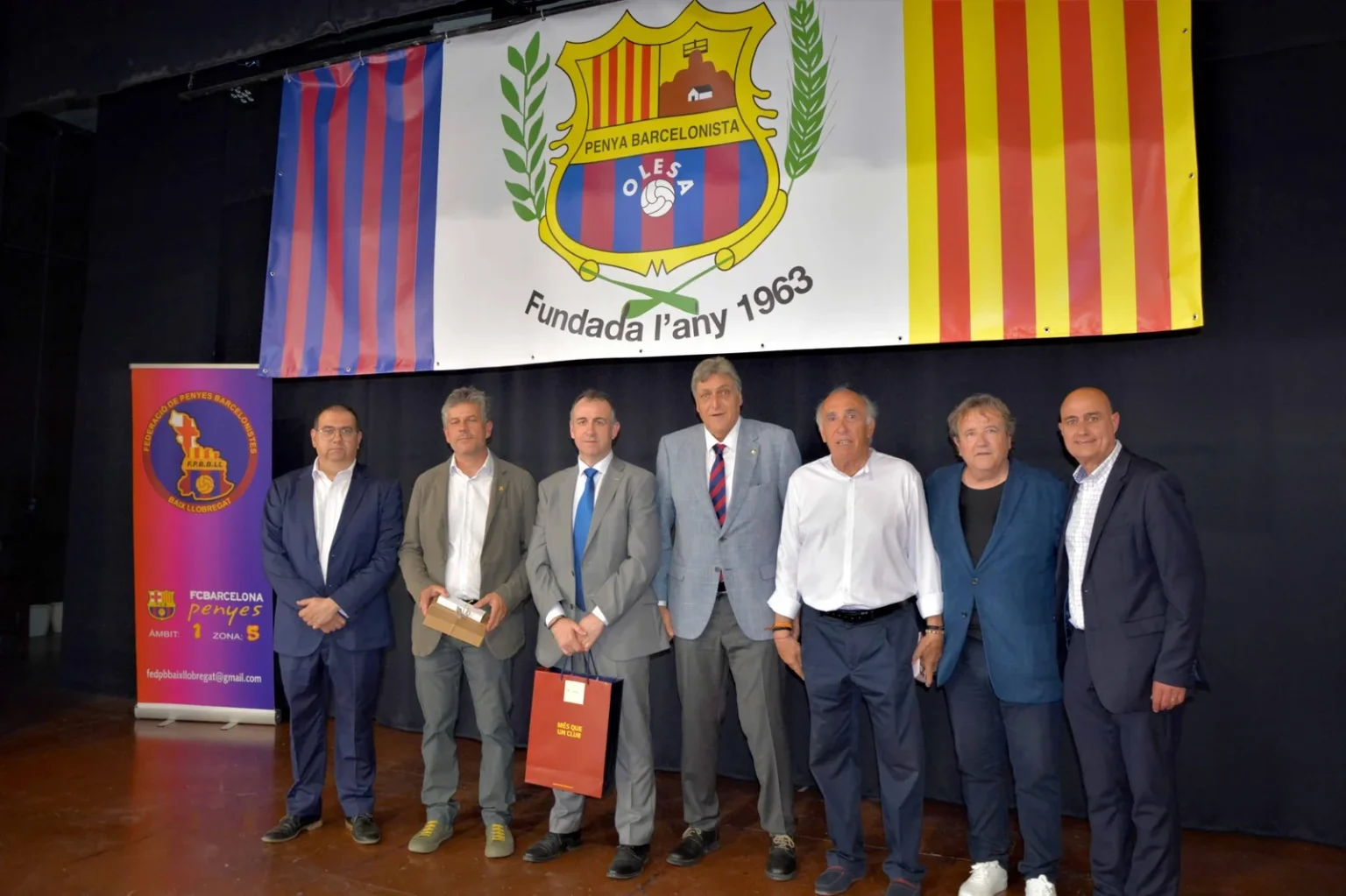
Baix Llobregat was one of the earliest driving forces in the world of FC Barcelona supporters’ clubs, and Olesa de Montserrat was one of the first towns in the county to commit to creating a social supporters’ club in a challenging environment for this type of association: Penya Barcelonista d’Olesa. Its president, Antoni Pérez, provides us with information about the supporters’ club and the town of Olesa.
More than 60 years of history
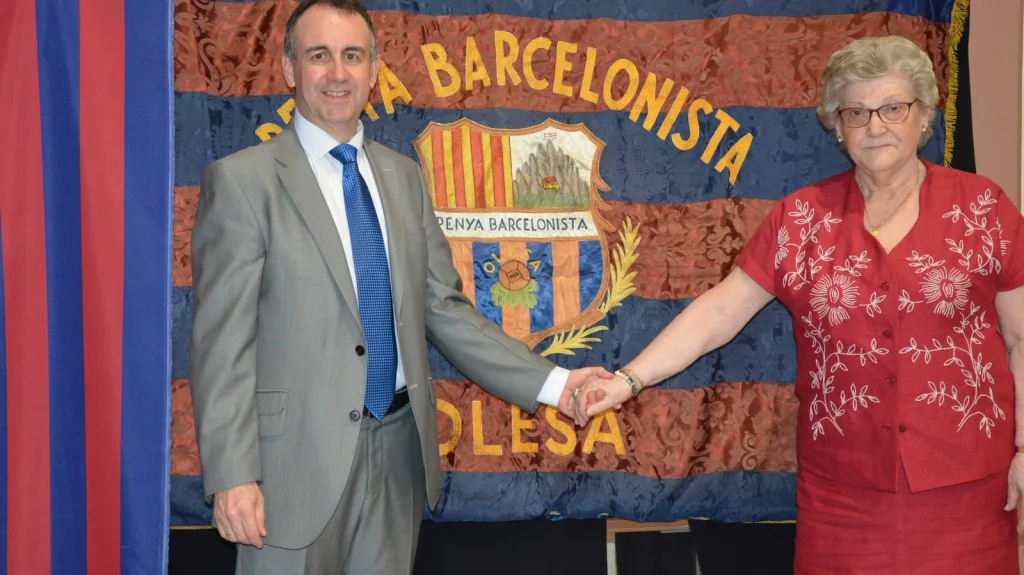
Founded in 1963, Penya Barcelonista d’Olesa is the home of Barça supporters in the municipality. Always driven by values such as respect, effort, ambition, teamwork and humility, the supporters’ club has sought since its creation to energize the town’s social and sporting life by organizing activities and creating a space where people can share their passion for Barça and good football. On 27 June 1987, the organization celebrated its first quarter century with an emotional event at Olesa Municipal Park, where a monument was unveiled to celebrate the work carried out over 25 years by the Olesa supporters’ club.
On 8 June 2013, the local blaugrana organization reached its 50th anniversary, a milestone it celebrated with a Barça-themed event at the municipal sports facilities. The gathering was attended by Jordi Cardoner i Casaus, then vice-president of the club; Paco Clos, former player and member of the Agrupació Barça Jugadors; Pau Vilanova Vila-Abadal, then board member responsible for the club’s Social Commission; Antoni Pérez, president of PB d’Olesa; and Vicens Notari, president of the Federation of Supporters’ Clubs of Baix Llobregat. As a sign of the municipality’s gratitude for half a century of the supporters’ club’s work, the then mayor of Olesa de Montserrat, Salvador Prat, and the second deputy mayor, Pere Planas, also attended. Both wanted to take part in that Barça celebration.
About Olesa de Montserrat
Olesa de Montserrat is a municipality located at the foot of the Montserrat mountain, at the head of the Baix Llobregat county and within the Montserratí subcounty. Its privileged location, between Barcelona and the Monastery of Montserrat, has made it a place with a rich history, a strong cultural tradition and outstanding architectural, festive and natural heritage.
One of Olesa’s most emblematic landmarks is the Clock Tower, listed as a Cultural Asset of National Interest. Located in Plaça Nova, in the old town and very close to the parish church, this construction stands out for its medieval origin and for the typical characteristics of a defensive tower formerly linked to a castle. Throughout its history it also served as the municipal prison, from the 18th century until the early 20th century, which reinforces its historical value within the municipality.
Olesa is known throughout Catalonia thanks to the Teatre de La Passió, home to one of the most important performances in Catalan popular culture: the Passion and death of Jesus. The current building was inaugurated in 1987 after the previous theatre was destroyed by fire. Designed by architect Joan Baca i Pericot, it has a capacity of almost 1,500 spectators. Its main attraction is the enormous 782-square-metre stage, considered one of the largest in Europe, as well as a 31-metre-wide proscenium opening, among the largest in the world. It also features modern technical mechanisms that allow scenery changes to be carried out quickly and spectacularly.
Another noteworthy landmark is the Portal de Santa Oliva, the only surviving gate of those that once protected the town. Built at the end of the 16th century, it is located in the northern part of the old town. In the 17th century, a chapel dedicated to Saint Olivia of Palermo, the municipality’s patron saint since 1664, was added. The saint’s relics, which arrived two years later, are still preserved in the Parish Archive. Devotion to Santa Oliva remains very much alive and is one of the town’s most important identity markers.
Olesa’s agricultural roots are also highly significant. Particularly notable is the cultivation of the palomar or olesana olive variety, which is exclusive to the municipality. This olive tree produces the prestigious Olesa Oil, marketed under the Oulesa brand. This oil is valued for its smoothness, low acidity and high oleic acid content. It is especially recommended for raw consumption, as it enhances the flavour of food. Its quality has been recognized over time with various international awards and distinctions, and there is even a tradition claiming that it was King Ferdinand VI’s preferred oil.
As for festive traditions, one of the most distinctive is the Festa dels Miquelets, held during the first week of September. This festival recreates the events of the War of the Spanish Succession (1705-1714) that took place in the municipality. Over several days, cultural activities, lectures, exhibitions and workshops are held. The highlight comes with the historical recreation of two military camps, one supporting the Habsburg side and the other the Bourbon side, as well as battles, Baroque markets and staged scenes that completely transform the town. The tribute to the 158 Habsburg soldiers who died in Olesa during the conflict is also especially noteworthy.
The Festa Major, held around Saint John’s Day, is another of the most eagerly awaited events for the people of Olesa. In addition, 10 June marks the Diada de Santa Oliva, the local festival dedicated to the patron saint. During this day, the streets are decorated with flowers and popular activities, music, religious events and a traditional floral offering are organized, with the participation of local organizations and authorities. Dances, sardanes and giants help create a very participatory festive atmosphere.
The Festa Major, held around Saint John’s Day, is another of the most eagerly awaited events for the people of Olesa. In addition, 10 June marks the Diada de Santa Oliva, the local festival dedicated to the patron saint. During this day, the streets are decorated with flowers and popular activities, music, religious events and a traditional floral offering are organized, with the participation of local organizations and authorities. Dances, sardanes and giants help create a very participatory festive atmosphere.
Finally, Olesa de Montserrat enjoys a privileged natural setting. The municipality is bordered by the Llobregat River and by the mountain ranges of Sant Salvador de les Espases and Puigventós. Among these spaces, Espai Natura Puigventós stands out as an area of great landscape, geological and ecological value. Its proximity to the river and the Montserrat massif offers landscapes of great beauty and remarkable natural diversity, making it one of the municipality’s main environmental attractions.
Overall, Olesa de Montserrat is a town that combines historical heritage, popular traditions, culture, gastronomy and nature, making it a prominent point of reference within the Montserrat area and Baix Llobregat.