
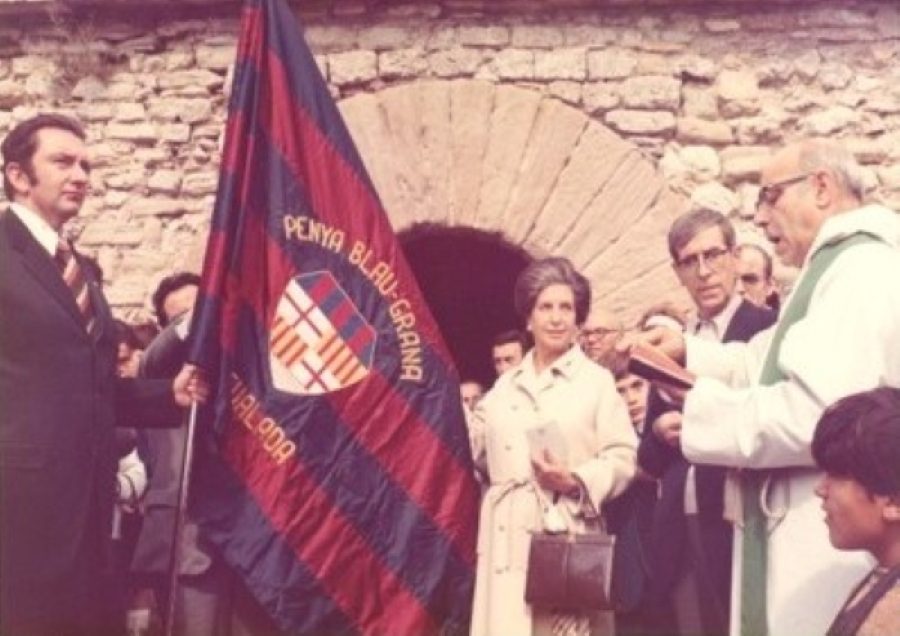
The Penya Blaugrana d’Igualada was born in January 1959, the result of the concern of a group of Igualada residents who wanted to crystallize their Barça sentiment by founding a penya culer; one of the first that FC Barcelona ever had. Behind was the Penya Germanor, which had been established before the War in this same city and disappeared once the conflict began. One of the notable promoters of that penya had been an eighteen-year-old named Nicolau Casaus, who organized trips to Barcelona to watch Barça matches, despite the very rudimentary conditions of the time.
The origin of PB Igualada (by Toni Claramunt)
“It is January 1959. The two promoters, Frederic Berguedà and Joan Miserachs, make a public call addressed to all those Igualada residents, admirers and supporters of CF Barcelona who might be interested in organizing the penya. The meeting, held on Monday, January 19 at the Cooperativa on Sant Magí street, gathers a total of fifty people, who unanimously support the project and approve the formation of a Management Committee.
Four days later –Friday, January 23–, at the same Cooperativa, the true founding assembly of the Penya Blau-Grana d’Igualada takes place with the presence of about sixty Barça supporters from Igualada. . The penya, with the title Blau-Grana –in Catalan and with two words joined by a hyphen–, is now born. The recently inaugurated Camp Nou sees how the ever-growing family of penyes continues to expand. The city of Igualada, for its part, gains a new entity; an enthusiastic entity, with the drive of youth and determined ideals, with the clear will to foster coexistence, friendship and citizenship around the most representative football club of Catalonia.” (Excerpt from the commemorative book for the 25th anniversary of PB Igualada, authored by Marcel·lí Valls)
The Management Committee that founded the penya was formed by Frederic Berguedà, Joan Miserachs, Modest Bosch, Joan Martí Comes, Robert Pelfort, Rosendo Plaza, Joan Prat, Francesc Salvador, Artús Segués, Marcel·lí Tort, Jaume Valls, Lluís Vidal. On January 23, the Constituent Assembly was held and the first 50 founding members were registered in alphabetical order, and from number 50 onwards, registrations for women began.
The penya has always been involved in the cultural world with various colloquiums, conferences, book presentations and other events at its premises, the same as the historic Ateneu Igualadí, which also appears in some previous episodes of the history of FC Barcelona penyes. The entity has been chaired by Joan Ollé (1959-1969), Joan Santacana (1969-1973), Joan Sabaté (1973-1985), Ramon Felip (1985-1989), Manel Roca (1989-1992), Antoni Codina (1992-1999), Ramon León (1999-2009) and Toni Claramunt (2009-present).
The city of Igualada
Igualada was founded around the year 1000, on the left bank of the Anoia river, which gives its name to the region. The name Igualada comes from the Latin aqualata, meaning “where the river widens.” A river that throughout history has been well used to supply the tanning industry or for hydraulic energy for mills. Old Igualada is a walled enclosure of small and winding streets around the church of Santa Maria. In 1381, Igualada received the title of Carrer de Barcelona and came under the tutelage of the city of Barcelona, gaining equal rights, freedoms and prerogatives.
In the municipality, you can find an old town with remnants of the wall and its gates, the Basílica de Santa Maria (originating from a Romanesque chapel), the Asil del Sant Crist (an eclectic art construction), the Romanesque church of Sant Jaume Sesoliveres, the new Park and Cemetery (work of Enric Miralles), the Museu de la Pell, the Museu del Traginer, the Renaissance cloister of the former convent of the Agustins, or the Rec (a canal that runs east to west along the southern side of the old town and has become an industrial district of tanners). As a detail related to FC Barcelona, two club directors have been linked to Igualada: the aforementioned Nicolau Casaus de la Fuente Jené, and Josep Mussons Mata.
Article with the collaboration of Toni Claramunt.